

Customers no longer open live chat to learn. They open it to verify.
Today’s customers increasingly turn to AI search tools before they ever type a message into a support widget. Whether they’re comparing plans, troubleshooting a feature, or clarifying a policy, many arrive with answers already formed by AI-generated responses.
By the time a conversation starts, the question is often not “What is this?” but “Is this correct?” The earliest support experience now often happens outside your own site, as customers use AI platforms to find information before engaging with your business directly.

This shift is measurable. Research indicates that approximately 60% of U.S. adults utilize AI tools to search for information at least some of the time, indicating a clear shift away from traditional browsing toward AI-assisted discovery.
As a result, customer support no longer represents the first step in the journey. This change impacts business operations, requiring businesses to adapt their support strategies to meet customers where their journey actually begins.
Instead, support teams now respond to expectations shaped elsewhere. Live chat becomes a place for confirmation, clarification, or correction. That reality quietly moves customer support earlier in the funnel and raises the importance of what customers experience before the first message is sent.
In this article, we’ll cover:
- How AI search has become the new first contact in customer support
- Why AI-generated answers shape trust, tone, and conversation quality
- How pre-chat customer experience affects live chat outcomes
- What this shift means for modern support teams adapting to AI-driven discovery
Read on to discover how customer support is evolving, and why understanding what happens before a chat begins now matters as much as what happens during it.
AI search has become the new first contact
AI-powered search experiences now serve as the primary interface for customer support. Instead of opening a help center or scrolling through FAQs, customers increasingly ask AI tools direct questions and expect clear, ready-to-use answers. For many, that response marks the beginning of support. Modern AI agents play a crucial role here, automating and personalizing customer interactions at scale, and enabling proactive support that adapts to individual needs.
One reason AI answers feel more trustworthy than traditional search results is the combination of speed and clarity. AI tools instantly summarize information and present it in plain language, eliminating the need for users to compare multiple links or interpret conflicting pages. That makes AI-driven customer service answers feel decisive, even when the information is incomplete or outdated. When an answer arrives in seconds and sounds confident, customers are more likely to accept it at face value.
There’s also a perception shift at play. Traditional search feels like research. AI search feels like advice. Instead of “Here are some results,” users get “Here’s the answer.” That subtle difference changes expectations and reduces patience for exploration. By the time customers open live chat, many believe the hard work is already done.
This has a direct impact on the role of live chat. Agents are no longer the first source of truth. They become validators, explainers, and sometimes correctors of AI-generated responses. Conversations start deeper, but also with more assumptions baked in. Live chat moves from discovery to alignment. AI-powered contact center solutions are transforming operations by integrating these AI agents, streamlining workflows, and enhancing the overall customer experience.
A quick comparison highlights how the support journey has changed:
| Support touchpoint | Traditional journey | AI-driven journey |
|---|---|---|
| First interaction | Help center or search results | AI-generated answer |
| User mindset | âI need to find information.â | âI already have an answer.â |
| Role of live chat | Explain and guide | Confirm or correct |
| Timing of trust | Built during conversation | Formed before chat starts |
After reviewing the comparison, it's essential to note the key features of modern AI-powered customer support solutions, including seamless integration with voice, chat, email, and social media channels, robust ecosystem connectors, and advanced automation capabilities.
Fun fact: Studies show that a majority of users now turn to AI tools for informational queries at least occasionally, and younger audiences do so even more frequently. That behavior signals a lasting shift, not a temporary experiment.
The result is clear: AI search customer support now starts outside your website. The earliest support experience often happens on an AI platform you don’t own, long before a chat widget loads. That’s why customer support before chat has become a critical moment, shaping trust, tone, and expectations before a single message is ever sent.
AI can operate 24/7, maintain consistent interaction across all channels, including voice, and help reduce operational costs by automating processes and deflecting tickets. By 2027, modern AI agents will be able to retain context across multiple sessions, resulting in more personalized and effective customer interactions.
Connect with customers
LiveChat® is a complete customer service platform that delights your customers and fuels your sales.
Trusted by 36,000+ companies

What customers bring into the chat today?
Modern chat conversations rarely start at the beginning. They start mid-journey.
By the time a customer opens live chat, many have already consulted an AI search tool and formed a clear opinion about their issue. Those AI-generated answers provide customer support explanations, suggested fixes, and product context before a human agent ever joins the conversation. As a result, customers don’t arrive with open-ended questions.
They arrive at conclusions. Increasingly, AI-driven customer engagements are shaped by analyzing multiple data sources, allowing AI to deliver more accurate and contextually relevant responses.
Midway through the conversation, this reality becomes visible in a few common ways:
- Quoting or pasting AI-generated responses directly into chat
- Referencing steps or recommendations suggested by an AI tool
- Questioning why the live response differs from what “the AI said”
- Expecting a quick yes-or-no confirmation rather than a full explanation
AI's ability to analyze customer data enables more personalized experiences, which and turn boosts customer satisfaction.
It’s increasingly common for support teams to see screenshots or copied text from AI tools used as evidence. These moments shift the balance of the interaction. Instead of asking for help, customers ask for validation. Predictive analytics in AI can also identify potential issues before customers even ask, and AI can flag at-risk customers to help retain them.
This change significantly reshapes the pre-chat customer experience. Expectations are set earlier, often outside your website or help center. When AI answers are accurate and aligned, conversations feel faster and more productive. When they aren’t, support inherits confusion or skepticism that started long before the chat opened.
Conversation quality changes as well. Chats become more focused, but also more sensitive. Agents must respond with precision, acknowledge what the customer already believes, and correct misunderstandings without coming across as dismissive or condescending. Tone and clarity matter more because trust is already partially formed.
In practice, live chat now acts as a confirmation layer rather than a discovery channel. Support teams that recognize what customers bring into the chat can respond more effectively, preserve trust, and guide conversations toward resolution instead of rehashing the journey from the beginning.
When AI answers get it wrong, support feels the impact
AI answers don’t break loudly. They drift.
AI search tools don’t verify what’s true today. They surface what’s easiest to find or most repeated in training data, not what’s actually correct in the present moment. When documentation is outdated, or product language changes faster than content is updated, AI-generated answers to customer support can present incorrect information with confidence. Customers rarely see that gap. Support teams always do.
One of the most common issues is the resurfacing of outdated or inconsistent information, as if it were still current and relevant. Deprecated features, retired plans, or revised policies can still appear in AI answers long after they’ve changed.
Maintaining an up-to-date knowledge base is crucial to ensure AI-generated answers are accurate and reflect the latest information. From the customer’s perspective, the information sounds authoritative because the AI delivered it with confidence.
A real-world example of this problem is the deployment of AI-generated search summaries in mainstream search engines. When Google introduced AI-generated overviews atop search results, users quickly shared bizarre or false recommendations, including one suggesting unsafe or nonsensical actions, prompting the company to tweak the feature to reduce those errors.
Inconsistent product language amplifies the problem. When the same product is described differently across pages, in marketing copy, help docs, release notes, or community threads, AI systems blend those versions together. The result is an answer that sounds plausible but doesn’t match reality. Customers arrive at live chat convinced they’re right, because the AI sounded sure.
That mismatch directly affects support performance:
-
- Agents spend time correcting assumptions instead of resolving issues
-
- Conversations slow down as trust has to be rebuilt
-
- Resolution time increases, even for simple questions
This is where poor AI search visibility becomes a support issue, not a marketing one. When accurate, up-to-date support content is not clearly surfaced by AI systems, the cost is evident in increased chat volume, longer handle times, and customer frustration.
AI can help manage and automate support processes, streamlining workflows so agents can focus on more complex issues that require human intervention. The consequences aren’t lower traffic or weak conversion rates; they’re longer conversations, more difficult escalations, and agents being forced into damage control.
Treating AI answer accuracy as part of the support experience is no longer optional; it’s essential for maintaining conversation quality in an AI-driven world. As AI is used to automate repetitive tasks and streamline customer support workflows, it is critical to prioritize security and protect personally identifiable information.
Data security and bias are critical concerns when utilizing AI in customer support, and robust measures must be implemented to safeguard sensitive data and ensure trustworthy interactions.
What is Generative Engine Optimization (GEO)?
Generative Engine Optimization (GEO) is the practice of making sure your content is understood, selected, and accurately summarized by AI systems, not just indexed by search engines.
Traditional SEO is built around rankings. Pages compete for visibility in a list of links, and users decide what to click. GEO works differently. AI search tools don’t present ten blue links. They generate a single answer by pulling from multiple sources, blending information, and rewriting it in their own words. The goal is no longer to rank first, but to be included correctly.
That difference matters.
Classic SEO asks, “How do we get users to our page?” GEO asks, “How does an AI system understand and represent our information?”
AI systems summarize instead of rank because their job isn’t discovery, it’s resolution. Users aren’t browsing. They’re asking direct questions and expecting direct answers. To meet that expectation, AI tools scan available web content, identify patterns, extract key facts, and compress them into a short response that sounds complete and confident.
In these processes, AI leverages information from various sources, including blogs and marketing websites, to guide and automate customer support workflows. AI also makes sense of large datasets to uncover trends and improve products and services.
In this process, nuance is often lost, and inconsistencies become more pronounced. Additionally, AI helps maintain consistent brand messaging across all support channels.
Why AI systems summarize instead of rank
AI systems summarize because their purpose is resolution, not exploration. Users don’t come to AI search to browse or research. They ask direct questions and expect direct answers.
To meet that expectation, AI tools scan available content, identify recurring explanations, extract key facts, and compress them into a short response that sounds complete and confident. In addition to summarizing, AI-driven tools assist customer support agents by providing real-time guidance and support, helping them deliver accurate and efficient responses.
In this process, nuance often disappears. If different versions of the same information exist, the AI does not pause to decide which one is correct. It blends them.
This is why AI answers can sound authoritative while still being partially wrong. The system is optimizing for clarity and speed, not verification.
Why support content has an outsized influence
Support content plays a central role in GEO because it often contains the most explicit explanations of how a product works. Help articles, FAQs, pricing explanations, and policy pages give AI systems concrete material to draw from when answering customer questions.
When that content is outdated or inconsistent, AI-generated answers inherit those flaws. When it is aligned and well-maintained, AI responses are more likely to reflect reality. Support teams, often unintentionally, become key contributors to how AI systems describe their product to customers.
The team collaborates closely to ensure content accuracy and alignment, which directly impacts the quality of AI-generated responses.
Why consistency matters more than ever
AI systems rely heavily on clarity and repetition. When features, plans, or workflows are described differently across documentation, AI systems have no reliable signal for which version is correct. They merge the information into a single explanation, even if the details conflict.
Consistent terminology, stable explanations, and up-to-date documentation help reduce that ambiguity. When the same concepts are explained the same way across channels, AI systems are more likely to generate answers that align with official support information. Additionally, it is crucial to ensure that all support content and AI-generated answers protect personally identifiable information, preventing the inadvertent exposure of sensitive data.
Why GEO is a support challenge, not a marketing one
GEO is often mistaken for a new form of SEO, but its impact is felt most clearly in customer support. The consequences show up in chat transcripts, not analytics dashboards.
When AI-generated answers align with official support guidance, customers arrive with accurate expectations, and conversations proceed smoothly. When they don’t, support teams spend time correcting assumptions, rebuilding trust, and resolving confusion that started before the chat ever opened.
Support agents are directly affected, as they must adapt to these challenges by addressing misinformation and ensuring that customers receive accurate and helpful responses.
That makes GEO a support operations issue as much as a content or SEO concern.
How teams approach GEO in practice
Teams typically improve GEO by paying closer attention to how support knowledge is created, updated, and aligned across channels.
They review high-impact documentation, standardize language, and observe how AI systems summarize their product and policies. AI can also help route cases to the most suitable agent, ensuring that customer inquiries are handled by the representative best equipped to provide a faster resolution.
Some teams also utilize specialized geospatial analysis tools to understand how AI systems present and surface their information. These tools are used to evaluate accuracy and representation, not to generate or write content.
GEO as part of the modern support stack
GEO sits at the intersection of AI search and customer support. As AI becomes the first place customers go for help, optimizing how answers are generated becomes as important as optimizing response times.
GEO and AI-powered support solutions also help teams scale their operations efficiently, enabling them to meet growing customer demand without the need to immediately expand their support team.
Support no longer starts when a chat opens. It begins with the information that AI systems find, and how accurately they convey the story.
Useful GEO tools for understanding AI answers
As GEO becomes more relevant, teams are starting to look for ways to understand how AI systems actually surface and summarize information about their products. This isn’t about creating new content or optimizing copy. It’s about visibility into interpretation.
GEO-focused tools help teams see what AI systems are likely to reference, how answers are framed, and where inaccuracies or gaps appear. They act as a layer of observability between official documentation and AI-generated responses. Instead of guessing how an AI arrived at an answer, teams can analyze patterns and identify where support content may be unclear, inconsistent, or outdated.
Some teams utilize Generative Engine Optimization (GEO) tools, such as Writesonic, to understand how AI systems surface answers about their products and to ensure that official support information is accurately reflected in AI-generated responses.
Other tools play a complementary role. AI search platforms like Perplexity and Gemini can be used to manually audit how support questions are answered in real time. Search performance and crawling tools such as Google Search Console help teams identify which documentation is most visible and authoritative. Content monitoring and brand intelligence tools can surface discrepancies between official messaging and third-party explanations that AI systems may rely on.
Used together, these tools function as diagnostic instruments. They don’t replace documentation or support workflows. They help teams spot where AI summaries diverge from reality and prioritize updates that reduce friction before conversations start.
Below is a simplified view of how different tools support GEO analysis from a customer support perspective:
| Tool or category | Primary role in GEO | How support teams use it |
|---|---|---|
| GEO analysis tools | Analyze how AI systems surface and summarize information | Identify gaps between official support content and AI-generated answers |
| AI search tools (ChatGPT, Perplexity, Gemini) | Show real-world AI responses to support questions | Audit accuracy and tone of AI answers customers are likely to see |
| Search analytics tools | Reveal which pages are most visible and authoritative | Prioritize which documentation influences AI summaries |
| Content monitoring tools | Track external references and explanations | Detect conflicting or outdated information that AI may pull from |
For support teams, the value of these tools is practical. They help reduce corrective conversations, shorten resolution times, and protect trust before chat even begins. As AI search becomes a permanent first point of contact, understanding how answers are generated becomes part of maintaining a high-quality support experience.
After using GEO tools to analyze your support content and AI-generated answers, the next steps are to implement recommended changes, enhance self-service resources, improve agent productivity, and use operational insights to continuously refine your customer support strategy.
How support teams can influence AI answers
Once AI search becomes the first place customers look for help, support teams can no longer treat documentation as a background asset. It becomes a front-line experience. The way content is written, structured, and maintained directly affects how AI systems present your product before a chat even begins.
The first shift is mindset. Help center articles are no longer written only for customers who click through pages. They are also read, parsed, and summarized by AI systems. That means every support article doubles as AI-facing content. Clear headlines, direct answers, and consistent terminology make it easier for AI to extract the right information and present it accurately.
Vague language and scattered explanations do the opposite. Agent-assist tools and AI agents help support teams deliver accurate answers in real-time, improve agent productivity, and provide coaching and training, allowing agents to focus on more complex, empathy-driven tasks.
Alignment across channels is just as important. Customers move between FAQs, documentation, chat conversations, and AI-generated answers without distinguishing between them. AI-powered self-service options, such as virtual agents and chat portals, enable customers to resolve issues independently, increasing efficiency and deflecting tickets.
When the same feature or policy is described differently in each place, AI systems merge those versions into a single explanation. Support teams can reduce that risk by standardizing language across FAQs, help articles, macros, and live chat responses.
When humans and documentation speak the same way, AI answers tend to follow. AI also delivers personalized experiences by analyzing customer data and preferences, improving customer satisfaction through tailored responses.
Contradictions deserve special attention. Many inaccuracies in AI answers come from content drift rather than outright errors. A help article might reflect an older workflow, while chat agents follow an updated process.
AI systems don’t know which one is current. They blend both. Regularly reviewing high-impact support content and updating it to match how agents actually resolve issues helps close that gap. AI can manage customer interactions across multiple channels and help reduce support costs by automating repetitive questions and directing them to self-service options, freeing agents to focus on empathy-driven tasks.
Some teams also use GEO-focused analysis tools to observe how AI systems summarize their support information. Writesonic, for example, has a dedicated Action Center which suggests the exact changes teams need to make to their content and website to improve their AI visibility. Support teams just need to implement the recommended actions within the platform to fix the visibility issues. Used in this way, these tools help teams identify mismatches between official documentation and AI-generated responses, without altering how content is written or produced. The goal is visibility, not automation.
Influencing AI answers doesn’t require rebuilding your help center from scratch. It requires treating support knowledge as a shared source of truth for both humans and machines. When support teams take ownership of that responsibility, AI-generated answers become more accurate, chats become more productive, and customers arrive with expectations that match reality.
Being present across multiple channels is essential to maximize customer reach and facilitate easier customer engagement.
Measuring the impact of AI search on support performance
Understanding how AI-powered search enhances support performance is crucial for any organization aiming to deliver enhanced customer experiences. With AI now providing instant, accurate answers to customer questions, the entire support interaction becomes more efficient and satisfying for both customers and agents.
One of the most significant benefits is the boost in customer satisfaction. When customers receive precise, relevant answers in real time, often before they even reach a human agent, they feel heard and valued. This immediate resolution of common issues not only enhances the customer journey but also builds trust in your brand’s ability to deliver consistent, high-quality service.
For support teams, AI search has a direct impact on agent productivity. By surfacing the right information at the right moment, AI reduces the time agents spend searching for solutions or clarifying details.
This means agents can focus on more complex customer conversations, resolve issues more quickly, and handle a higher volume of inquiries without compromising quality.
The result is a more streamlined workflow and a noticeable improvement in overall support efficiency.
Measuring these improvements involves tracking key metrics, such as first-contact resolution rates, average response times, and customer satisfaction scores. Organizations can also monitor the accuracy of AI-generated answers and the frequency with which customers require escalation to a live agent.
When analyzing these data points, support leaders gain actionable insights into how AI search is shaping the entire customer experience, from the first question to final resolution.
Ultimately, integrating AI-powered search into your support platform isn’t just about adopting new technology; it’s about elevating every support interaction. When customers consistently receive accurate answers, and agents are empowered to work more efficiently, the impact is clear: higher customer satisfaction, stronger support performance, and a more resilient, customer-centric organization.
Why pre-chat experience now determines chat success
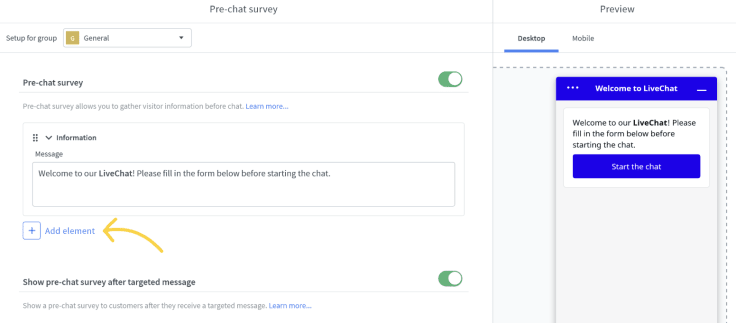
By the time a customer opens live chat, the conversation is already moving in a certain direction. The answers they’ve seen, the assumptions they’ve formed, and the confidence they bring all influence how quickly and smoothly the interaction unfolds. That’s why pre-chat experience now plays such a decisive role in chat success.
When customers arrive with accurate context, confirmations occur more quickly. They don’t need a full explanation or a long back-and-forth. They’re looking for reassurance, a small clarification, or the final step to move forward. Agents can meet them where they are and focus on resolution instead of reorientation.
Consistency also builds trust early. When an AI tool explains something before a chat aligns with what a human agent confirms in the chat, customers feel more confident from the first message. That alignment signals reliability and reduces hesitation. Conversations feel calmer, more cooperative, and easier to guide.
The most significant shift is evident in what doesn’t happen. Fewer corrective conversations. Less time spent explaining why an answer was outdated or incomplete. Fewer moments where an agent has to reset expectations that formed elsewhere.
When pre-chat information is aligned, support teams spend more time solving problems and less time repairing context. In fact, AI-driven efficiencies can save support teams several hours each week by streamlining workflows and reducing repetitive tasks.
This is why customer support before chat has become a real competitive advantage. Teams that invest in the pre-chat experience create faster, clearer, and more productive conversations. In an environment where AI shapes expectations early, the quality of chat is increasingly determined by everything that happens before the first message is sent.
Connect with customers
LiveChat® is a complete customer service platform that delights your customers and fuels your sales.
Trusted by 36,000+ companies
Support doesn’t start with “Hi” anymore
Customer support no longer begins when a chat window opens. It begins earlier, when someone asks an AI search tool for help. That first answer sets expectations, frames understanding, and influences how every subsequent conversation unfolds.
AI search has quietly moved the starting line of customer support. Teams that recognize this shift reduce friction before it reaches live chat. They spend less time correcting assumptions, build trust faster, and have more productive conversations from the very first message.
Meeting customers where they are today means meeting them informed, curious, and often looking for confirmation rather than discovery. AI agents now provide human-like interactions that mimic natural conversation, enhancing the customer experience from the very first point of contact. Support doesn’t start with “Hi” anymore. It starts with the answers customers see before they ever reach out.
Want to turn those pre-chat moments into better conversations?
Discover for free how LiveChat enables teams to meet customers at the right moment and transform informed visitors into faster, smoother support interactions.